
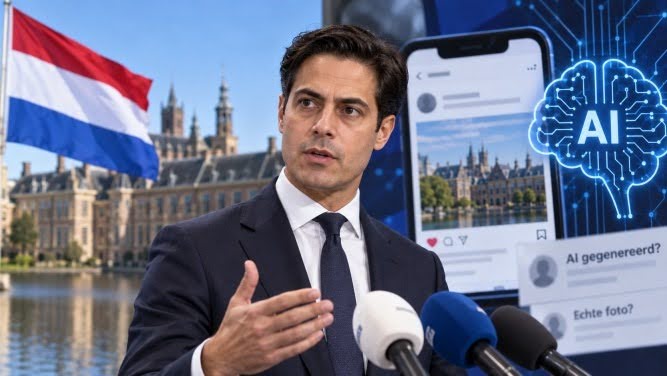
The Dutch Prime Minister, Rob Jetten, and his political party, D66, have come under scrutiny for their use of artificial intelligence to create hundreds of social media posts. This revelation has sparked concerns about the authenticity of such communications and the potential impact on public trust. An analysis of Jetten’s and D66’s social media activity across platforms like X, Instagram, Facebook, and LinkedIn since 2021 revealed that at least 232 out of 1,812 posts were generated using AI chatbots. Among these, 68 were from Jetten’s personal accounts, while 164 originated from the party’s accounts.
The reliance on AI for social media content reportedly surged following the collapse of the Schoof I Cabinet in June 2025. After this event, approximately 30% of posts from both Jetten and D66 were identified as AI-generated. AI technology was also employed in parts of Jetten’s book, “Hoe het wél kan,” and in three campaign videos for D66. Notably, some AI-assisted posts addressed sensitive topics such as the war in Ukraine, the MH17 disaster commemoration, and the government’s apology to the Moluccan community.
D66 has acknowledged their use of AI, emphasizing that all content undergoes review and refinement by their staff. The party assures that posts on Jetten’s personal accounts are grounded in his own input and receive his approval or edits. Despite these assurances, experts express concern that presenting AI-generated material as if it were direct communication from Jetten might undermine his credibility. Claes de Vreese, a professor at the University of Amsterdam, has cautioned that AI-generated language could blur the line between a politician’s genuine views and computer-generated messaging.
This issue highlights larger questions around transparency and the role of AI in political communication, particularly when it comes to the expectation that official social media accounts should accurately reflect the personal views and words of elected officials. As AI continues to play a growing role in shaping public discourse, the challenge will be ensuring clarity and honesty in political messaging to maintain public confidence.