
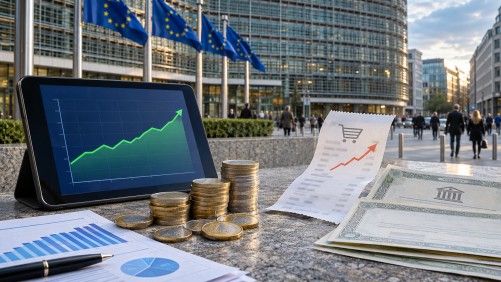
The European Union’s economy is projected to maintain moderate growth over the next few years, even as it faces challenges from persistent inflation and rising government debt. According to the European Commission’s Autumn 2026 Economic Forecast, the EU’s economic growth is expected to reach 1.4% in 2026 and continue at a similar pace through 2028.
While the economic outlook shows resilience, the forecast highlights concerns over inflation, which is set to remain elevated. EU inflation is projected to be 3.3% in 2026, slightly easing to 3.2% in 2027 and 2.3% in 2028. The eurozone’s inflation is expected to follow a similar trend, with rates of 3.2% in 2026, 3.1% in 2027, and declining to 2.1% by 2028.
Several factors are supporting the EU’s economic growth. Stable consumer spending and a recovery in goods exports, particularly in intermediate products for artificial intelligence and electrification projects, have contributed to the positive performance. However, the European Commission warns that geopolitical tensions, uncertainties in international trade policies, and financial market instability could pose risks to this growth trajectory.
The report also points to rising government debt as a significant concern. Increased defence spending, higher interest payments, and financial support measures for households and businesses are expected to widen government budget deficits. The EU’s debt-to-GDP ratio is predicted to rise from 82.6% in 2025 to 85.6% in 2028, potentially constraining member states’ financial flexibility in facing future economic challenges.
Households across Europe are feeling the pressure of higher living costs, which are affecting purchasing power. Private consumption growth is projected to slow down, with growth rates of 1.3% in 2026 and 1.1% in 2027. Additionally, investment activity may remain subdued due to elevated interest rates increasing borrowing costs.
The European Commission emphasizes the need for member states to strengthen public finances, enhance economic competitiveness, and encourage investment to support sustainable long-term growth. Despite the forecasted growth, balancing economic expansion with inflation control and financial stability remains a critical challenge for Europe.