
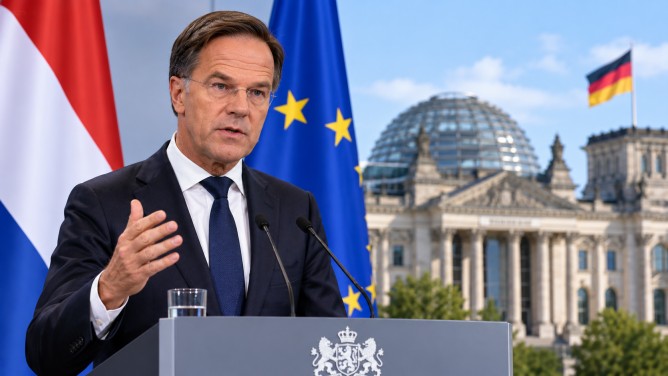
In a significant political development, the far-right Alternative for Germany (AfD) has achieved a notable electoral success in Saxony-Anhalt, securing 43.8 percent of the vote. This outcome has been described by Dutch Prime Minister Rob Jetten as a “wake-up call” for German politics. Jetten, while acknowledging voters’ rights to choose their representatives, expressed concerns over the AfD’s extreme views and its perceived pro-Russian stance. He called on German political leaders to scrutinize the reasons behind the party’s strong support and address voters’ concerns effectively.
The election results placed the AfD ahead of other major parties, with the Christian Democratic Union (CDU) garnering 17.2 percent, the Social Democratic Party (SPD) at 9.3 percent, the Greens with 8.9 percent, and Die Linke at 8.6 percent. The BSW party also managed to enter the state parliament with 5.3 percent of the vote. Despite the AfD’s impressive showing, the party did not secure enough seats for an outright majority, leaving the formation of a stable state government in question as other parties have ruled out cooperation due to the AfD’s controversial positions on issues like migration.
The AfD’s performance has triggered alarm among European political leaders, with officials in countries such as France and Poland highlighting the growing challenge posed by far-right movements. In contrast, Hungary’s former prime minister Viktor Orbán congratulated the AfD on their success. The election has also raised concerns among German officials about threats to democratic values and the influence of Russian narratives. Reports of misinformation and foreign interference during the campaign have added to the debate over the factors driving the AfD’s popularity.
Looking ahead, the AfD aims to capitalize on its success in Saxony-Anhalt by setting ambitious goals for the national stage. Party co-leader Alice Weidel has announced a target of winning at least 40 percent of the vote in the next federal election, signaling the AfD’s intent to become Germany’s largest party. However, achieving such a goal may prove challenging, given the reluctance of other parties to engage in coalition talks with the AfD.
This election has intensified discussions across Germany and Europe regarding the rise of far-right political movements, voter dissatisfaction, and the future trajectory of German politics. As the country grapples with these issues, the response from political leaders will be crucial in shaping the political landscape and addressing the growing support for far-right ideologies.