
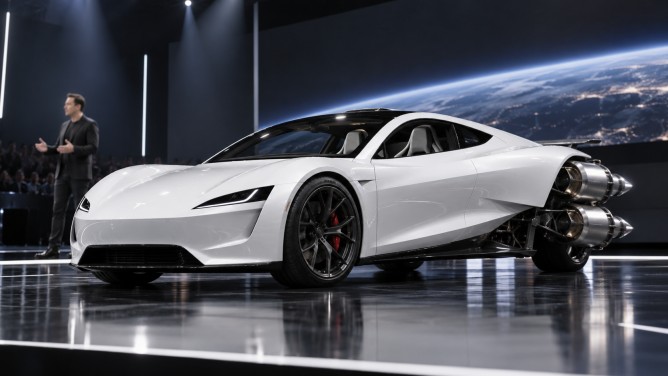
Elon Musk has introduced a prototype of the Tesla Roadster 2, equipped with rocket-thruster technology from his aerospace company, SpaceX. The demonstration, held in Texas, showcased the electric sports car driving up a curved ramp and using thrusters to perform aerial maneuvers before landing. Musk suggested that this could mark the beginning of flying car technology, with the Roadster 2 capable of executing complex movements through altitude controls and rear-mounted thrusters.
The demonstration was conducted remotely to mitigate safety concerns, and Musk noted that the vehicle might not be legal in all jurisdictions. Tesla plans to start production of the Roadster 2 in 2028, with an expected price tag exceeding $200,000. Various iterations of the vehicle are anticipated, including a performance model and a specialized version with a thrust system. Furthermore, a proposed single-seat rocket variant with a full flight system is expected to be made available by invitation only.
Tesla has cautioned that the vehicle’s flying capabilities are not intended for public road usage. The prototype’s demonstration underscores Musk’s ambition to merge electric vehicle technology with rocket propulsion. However, the practical application, safety standards, and regulatory approval for such technology are significant factors that remain under consideration.
The unveiling of this prototype highlights Musk’s vision for future transportation, blending cutting-edge automotive and aerospace technologies. While the concept of a flying car is compelling, its realization faces hurdles in terms of regulations and safety protocols. As Tesla progresses towards production, these challenges will need to be addressed to make this vision a reality.